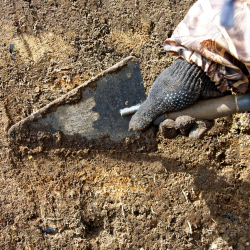
When archaeologists excavated a ceremonial site in Peru’s Churunga Valley in 1943, they uncovered a remarkable piece of Andean history: ninety-six brilliantly colored feather panels (600-900 CE), rolled and sealed inside ceramic jars. More than eighty years later, nine of the panels are back in the spotlight as part of the Met’s Wari Feathered Panels Exhibition, and photos sourced from IFR’s Corral Redondo field school archives are now part of the story the Metropolitan Museum of Art is telling about them.
The Wari were a highland Andean civilization that preceded the Inca by several centuries and in many ways laid the groundwork for the Inca Empire that followed. They established road networks, built ceremonial centers, and forged connections across a vast Andean territory. Corral Redondo, the site where the panels were found, is believed to have been a huaca, or sacred space, where the panels may have adorned walls or been carried as part of large ceremonial gatherings, surrounding participants in a theater of blue and gold.
Each panel is densely layered with tens of thousands of feathers, primarily from the blue-and-yellow macaw of the Amazonian rainforest. The feathers were individually hand-knotted onto strings, then stitched onto plain-weave cotton foundations. The result is a textile of staggering visual impact, currently on view at Gallery 363 at The Met. To accompany the exhibition, the museum produced an explanatory video featuring archaeologist Carol Rodríguez and conservator Christine Giuntini, who guide viewers through the craft, cultural significance, and history of the panels, including IFR’s archival photos illustrating the Corral Redondo site where these panels were first uncovered.
IFR hosted two field school seasons at the Corral Redondo Archaeological Project in 2018 and 2019. Although our Corral Redondo project has concluded, IFR’s Peru: Cajamarca Ethnoarchaeology field school explores similiar themes, tracing the living textile culture through Peru’s Andean communities. As part of the program, participants work closely alongside master weavers who carry forward more than 6,000 years of Andean textile knowledge, learning techniques from fiber preparation and natural dyeing to backstrap loom weaving. The program also includes visits to key archaeological sites, survey, and ethnobotanical fieldwork, connecting material culture from the past to the hands that still produce it today.
Share this article
Follow us
Latest articles
September 15, 2026
September 15, 2026
September 15, 2026